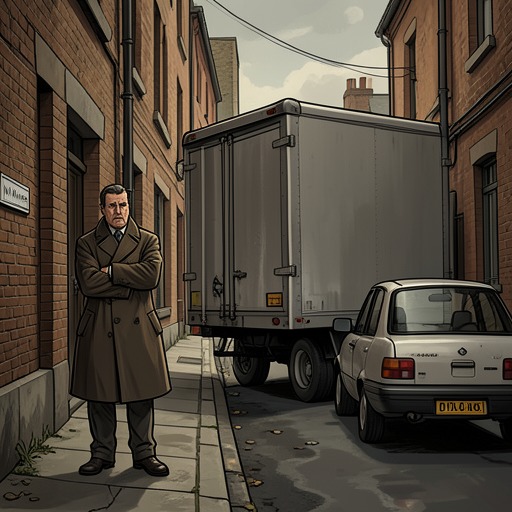
Ove begins shoveling snow for his neighbors
A Man Called OveOve begins shoveling snow for his neighbors the morning after he abandons an attempt to die in his garage. The work starts as a familiar task outside his own house, then crosses the road to the other homes: without announcing a change of heart or asking for recognition, he makes his labor useful to the people around him.
The Morning Routine
The previous evening, Ove had backed his Saab into the garage and left its engine running, but turned it off after looking at the cat. At quarter to six the next morning, he and the cat are up: Ove drinks coffee, the cat eats tuna, and together they finish their inspection round. Ove then carefully shovels the snow outside his own house and leans on the shovel by his shed, looking along the row of houses.
That sequence makes the act part of a return to ordinary life, not a sudden public declaration. Coffee, tuna, inspection, and snow clearing restore the order of a morning; the cat’s presence, already decisive the night before, is now woven into the routine that follows.
From His House to the Neighbors’
After finishing outside his own home, Ove crosses the road and starts clearing snow in front of the other houses. The change is small in distance but significant in scope: he moves from maintaining his own threshold to taking responsibility for a shared stretch of the neighborhood. The account gives no speech or stated reason for the extra work. Its meaning rests in the choice to continue shoveling after his own task is done.
The scene also gives practical form to a trait that can be obscured by Ove’s manner. At fifty-nine, he drives a Saab and is introduced as someone who points at people he dislikes as if identifying burglars. When Parvaneh asks whether he is always so unfriendly, he takes offense; when she orders him to stop being rude, he insists that he is not. The snow clearing does not erase that bluntness. Instead, it shows care expressed through work rather than through an easy display of warmth.
How the Neighbors See Him
Ove’s place among the neighbors is not defined by one shared judgment. Parvaneh openly challenges his behavior, while a three-year-old laughs that he is funny; the older child is much less impressed. These contrasting responses give the snow-shoveling scene a social context: Ove can be difficult to approach, yet his actions offer another way of being present in other people’s lives.
The episode’s significance lies in that contrast and in its timing. The morning follows a moment when Ove had thought death was the only logical end and then stopped the engine because of the cat. He does not explain what the neighbors’ snow means to him, and the scene does not claim that one act resolves his grief. It shows something more concrete: after choosing to stay, he resumes his routine and carries its usefulness beyond his own front door.